How Many Days Until the Next Holiday? 2026–2027 Dates and Countdowns
"How many days until Christmas?" has a single correct answer on any given day, but people get it wrong by one surprisingly often, and moveable holidays such as Easter, Diwali or Eid add a second problem: you first need the right date. This guide gives verified dates for the main holidays from November 2026 through December 2027, the exact day counts from a fixed date, and a method for counting by hand that you can check against a calculator.
How a days-until count works
A date calculator turns each date into a day number on a continuous count and subtracts:
days until = holiday date − today's date
Because it subtracts, today counts as day 0 and the holiday itself is the last day counted. If today is December 24, Christmas is 1 day away, not 2. That is the same convention as "days between two dates" and it is what the timeandcal Date Calculator uses: enter today's date and the holiday's date, and it returns the total days as well as months plus days.
The subtraction handles month lengths and leap years for you. 2027 is not a leap year, so there are 358 days from New Year's Day 2027 to Christmas 2027. In 2028, a leap year, the same count is 359.
Two things change the answer for the same holiday:
- Where you are. A web calculator usually reads "today" from your device's clock. When it is already January 1 in Sydney, it is still December 31 in New York, so the two cities see counts that differ by one for part of the day.
- Inclusive counting. If you count today and the holiday as whole days, add 1 to the calculator's answer. That is the usual cause of an off-by-one when you compare a hand count with a tool.
Holiday dates and countdowns, 2026–2027
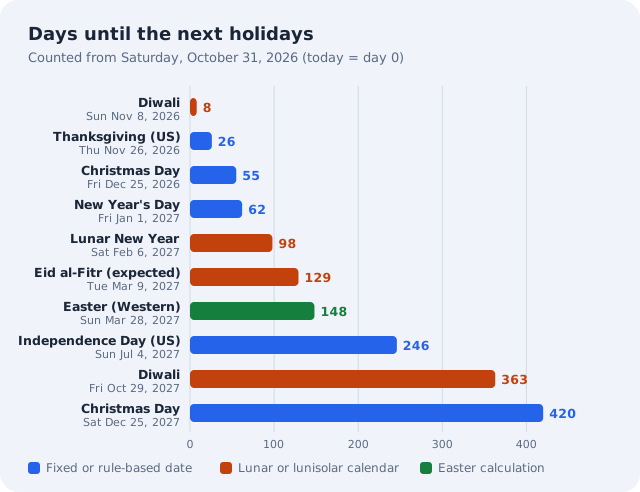
The table counts from Saturday, October 31, 2026. To get the count from a later date, subtract the number of days that have passed since then. Every count below was computed with Python's datetime module.
| Holiday | Date | Days away | How the date is set |
|---|---|---|---|
| Diwali | Sun, Nov 8, 2026 | 8 | Hindu lunisolar calendar |
| Thanksgiving (US) | Thu, Nov 26, 2026 | 26 | Fourth Thursday of November |
| Hanukkah begins (at sundown) | Fri, Dec 4, 2026 | 34 | 25 Kislev, Hebrew calendar |
| Christmas Day | Fri, Dec 25, 2026 | 55 | Fixed date |
| New Year's Day | Fri, Jan 1, 2027 | 62 | Fixed date |
| Lunar New Year (Year of the Goat) | Sat, Feb 6, 2027 | 98 | Chinese lunisolar calendar |
| Ramadan begins (expected) | Mon, Feb 8, 2027 | 100 | Hijri calendar; moon sighting or calculation |
| Eid al-Fitr (expected) | Tue, Mar 9, 2027 (or Mar 10) | 129 (or 130) | 1 Shawwal, Hijri calendar |
| Easter Sunday (Western) | Sun, Mar 28, 2027 | 148 | Sunday after the church's full moon |
| Orthodox Easter | Sun, May 2, 2027 | 183 | Same rule, Julian calendar |
| Independence Day (US) | Sun, Jul 4, 2027 | 246 | Fixed date |
| Diwali | Fri, Oct 29, 2027 | 363 | Hindu lunisolar calendar |
| Thanksgiving (US) | Thu, Nov 25, 2027 | 390 | Fourth Thursday of November |
| Christmas Day | Sat, Dec 25, 2027 | 420 | Fixed date |
Independence Day 2027 falls on a Sunday, so the US federal holiday is observed on Monday, July 5. Countdowns to a day off and to the holiday itself can differ in years like that. Diwali is a five-day festival and some regions mark it a day apart; the table gives the main day as listed in public-holiday calendars.
Fixed and moveable holidays
Holidays fall into three groups, and each needs a different approach to the countdown.
Fixed dates
Christmas, New Year's Day and July 4 have the same date every year, so the count only changes with today's date. The day of the week shifts by one each year, or by two after February 29.
Rule-based dates
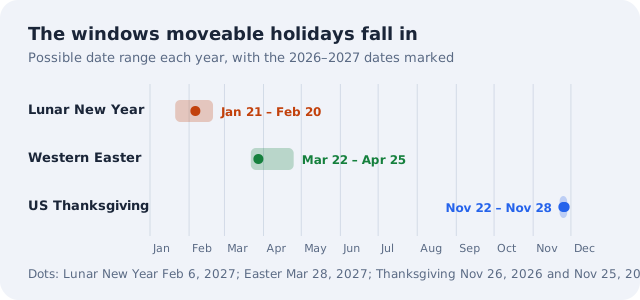
US Thanksgiving is the fourth Thursday of November, fixed by federal law since 1941. It can only land between November 22 and November 28. Western Easter follows a calculation: the first Sunday after the church's full moon on or after March 21, which places it between March 22 and April 25. Orthodox churches use the same rule on the Julian calendar, so their Easter is usually later; in 2027 it is five weeks later.
Lunar and lunisolar dates
Lunar New Year is the second new moon after the winter solstice in most years, so it falls between January 21 and February 20. Diwali, set by the Hindu lunisolar calendar, falls in October or November. Both stay in roughly the same season because their calendars add a leap month every few years.
The Islamic Hijri calendar is purely lunar, with years of 354 or 355 days, so Ramadan and the two Eids move about 11 days earlier each year against the Gregorian calendar. Their exact dates are not settled in advance everywhere. Many countries begin the month when the new crescent is actually sighted, while Turkey's Presidency of Religious Affairs fixes the dates by astronomical calculation and publishes them months ahead. For 2027, the UAE's Astronomy Centre expects Eid al-Fitr on March 9 if the crescent is sighted on March 8, otherwise on March 10.
Where the moon-sighting rule is used, the last day of Ramadan is confirmed only the evening before. Plan travel or time off with a one-day margin, and check the announcement from the authority your community follows.
How to count days by hand
You can count without a calculator by splitting the gap into three blocks: what is left of the current month, the full months in between, and the days into the holiday's month. Take October 10 to Christmas, December 25:
- Rest of this month: October has 31 days, so 31 − 10 = 21 days remain.
- Full months in between: November has 30 days.
- Days into the target month: Christmas is on the 25th, so 25.
- Add them: 21 + 30 + 25 = 76 days.
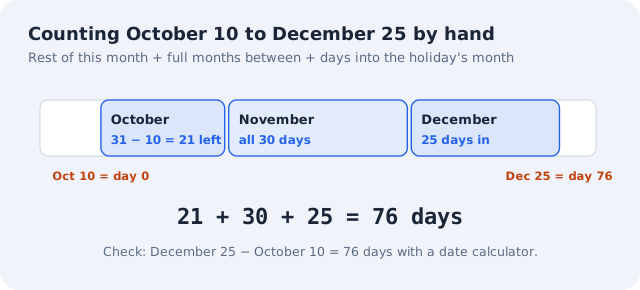
The first block uses 31 − 10, not 31 − 10 + 1, because October 10 itself is day 0. For month lengths, the old rhyme still works ("Thirty days hath September, April, June and November..."), or use the knuckle trick: counting across your knuckles and the gaps between them, every month that lands on a knuckle has 31 days. Only February is short, with 28 days, or 29 in a leap year such as 2028.
A worked example across a year boundary
From October 31, 2026 to Lunar New Year on February 6, 2027:
- October: 31 − 31 = 0 days left
- November 30 + December 31 + January 31 = 92 days
- February: 6 days
- Total: 0 + 92 + 6 = 98 days, which matches the table
For long gaps, converting to weeks makes the number easier to picture: 98 days is exactly 14 weeks, so Lunar New Year 2027 falls on the same weekday as October 31, 2026, a Saturday.
Countdowns beyond holidays
The same subtraction works for anything with a date. The timeandcal calculator also has a birthday and anniversary countdown that shows the days left and the age reached. For a visa stay or a project deadline, the counting rules can differ from a simple subtraction, so see how to calculate visa validity and business days vs calendar days, since a holiday countdown counts every calendar day, weekends included.
Quick checklist
- Confirm the holiday's date for the right year, especially for Easter, Diwali, Lunar New Year and the Islamic holidays.
- Subtract today's date from the holiday's date. Today is day 0.
- Add 1 only if you want to count both today and the holiday as whole days.
- Check whether the day off moves to a weekday when the holiday falls on a weekend.
- For Eid, keep a one-day margin until the date is announced.
Frequently Asked Questions
Sources
- Chanukah 2026 / חֲנוּכָּה 5787 — Hebcal
- Ramadan, Eid Al Fitr and Eid Al Adha 2027: likely dates — Khaleej Times
- When is the first day of Ramadan? A question dividing the Islamic world — Euronews
- Diwali 2026, 2027 and 2028 — PublicHolidays.com
- Chinese New Year 2027: dates, traditions and business impact — Examine China
- Thanksgiving as a Federal Holiday — National Archives (Prologue blog)
Count the days to any date
Enter today's date and the holiday's date in the timeandcal Date Calculator to get the total days, plus months and days, between them.
Open Date Calculator →